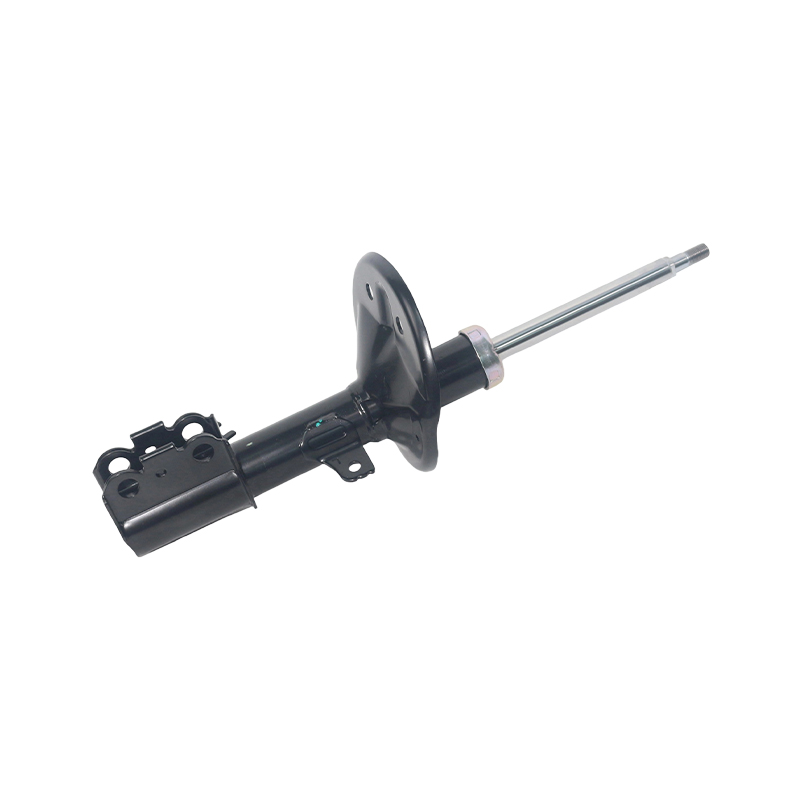
How does an automobile shock absorber tame every violent impact from the road?
Publish Time: 2026-03-02
In the grand narrative of the modern automotive industry, the engine gives a vehicle its soul, while the shock absorber is the silent, unseen guardian. When a vehicle speeds over potholes, speed bumps, or traverses rugged mountain roads, the road surface transmits violent and chaotic impact energy to the wheels. Without the intervention of a shock absorber, this energy would be directly transferred to the vehicle body and passengers, leading to loss of control and a complete loss of comfort. The core mission of an automobile shock absorber is to use a sophisticated physical mechanism to convert these intense mechanical vibrations into heat energy, thus "taming" every angry roar from the road surface and making the ride silky smooth.1. Hydraulic Damping: The Violent Resolution of Fluid DynamicsThe first line of defense for shock absorbers in taming impacts comes from their core hydraulic system. Traditional shock absorbers are filled with specially formulated hydraulic oil. When the wheel encounters an impact and moves upward, the piston moves rapidly within the cylinder, forcing the hydraulic oil through tiny valve orifices. This process generates enormous fluid resistance, i.e., damping force. This resistance is not simple friction, but an energy conversion mechanism based on fluid dynamics: it forcibly converts the kinetic energy of the wheel's up-and-down movement into the internal energy of the fluid molecules, which is then dissipated into the air through heat dissipation.For vehicles pursuing ultimate handling, ordinary hydraulic systems often struggle to cope with extreme conditions. This is where high-performance suspension systems come in. They employ low-friction sealing materials and faster-responding valve designs, enabling them to react to road surface changes within milliseconds. Whether it's subtle road texture or a sudden pothole, high-performance hydraulic shock absorbers provide linear and continuous damping force, ensuring the tires remain firmly in contact with the ground and neutralizing violent impacts.2. Diverse Forms: Customized Synergy of Front and Rear SuspensionThe front and rear axles of a car bear different mechanical tasks, therefore, shock absorber designs are far from uniform. Front suspensions typically need to balance steering agility with engine weight support, thus often employing a compact front-small shock absorber design. This design not only saves engine compartment space but also reduces unsprung mass, improving steering sensitivity and response, making the front end lighter and more agile when encountering impacts.In contrast, the rear suspension often needs to bear the weight of passengers, cargo, and the drive system, requiring higher stability and versatility. Rear universal shock absorbers play a crucial role here; they typically have stronger load-bearing capacity and wider adaptability, capable of handling various load conditions and ensuring the rear remains stable under heavy loads or bumpy roads. In certain specific layouts, the front shock absorbers are also specially tuned according to the vehicle's positioning, perfectly matching the front wheel steering geometry, together forming the foundation of the vehicle's dynamic balance.3. Intelligent Evolution: From Pneumatic to Electronic Control - Active TamingWith technological advancements, passive hydraulic damping can no longer satisfy people's pursuit of a "magic carpet" ride. Modern high-end models have begun to introduce adjustable pneumatic technology. Air springs replace traditional coil springs, allowing the vehicle to adjust suspension height and stiffness in real time by regulating air pressure within the air chambers. At high speeds, the system automatically lowers the vehicle to reduce wind resistance; in off-road mode, it raises the chassis to traverse obstacles. This pneumatic system offers a level of smoothness and adaptability unmatched by traditional steel springs.Furthermore, the addition of electric active control technology gives the shock absorbers a "brain." Through sensors distributed throughout the vehicle, the system can anticipate road conditions and instruct solenoid valves or motors to instantly adjust the damping coefficient. This active intervention means the shock absorbers no longer passively absorb impacts but actively "counteract" them. Whether it's nose-diving during hard braking or body roll during cornering, the electronic control system can instantly apply a counterforce, firmly locking the vehicle's posture.In summary, the automobile shock absorber successfully tames every violent impact from the road through the energy conversion of the hydraulic system, differentiated design of the front and rear axles, and the intelligent integration of pneumatic and electronic control technologies. It is not only a source of comfort, but also a cornerstone of safety, using the power of technology to turn rugged terrain into smooth roads, making every journey an enjoyable experience.